



We know that social ills such as substandard housing and food insecurity fuel sickness that falls to health care to address. Now more than ever, we are also asking health care to be in the business of preventing illness. What we don’t often consider—but should—is that many of these social and structural problems are also legal problems. And as such, they may have legal solutions.
What we can do is embed specialists on the healthcare team who are equipped to both enforce laws on behalf of patients and help change policies that create these structural problems in the first place. These specialists are civil legal aid lawyers. Over the last 20 years, more than 450 hospitals and health centers have formed such medical-legal partnerships (MLPs) to make lawyers part of their healthcare teams. The purpose is to elevate awareness of how health and the law intertwine and make our communities more just, and thereby more healthy, overall. And it’s spreading. In July 2021, HealthBegins and NCMLP announced a new initiative with Kaiser Permanente to connect health systems with legal resources for greater housing stability and eviction prevention.
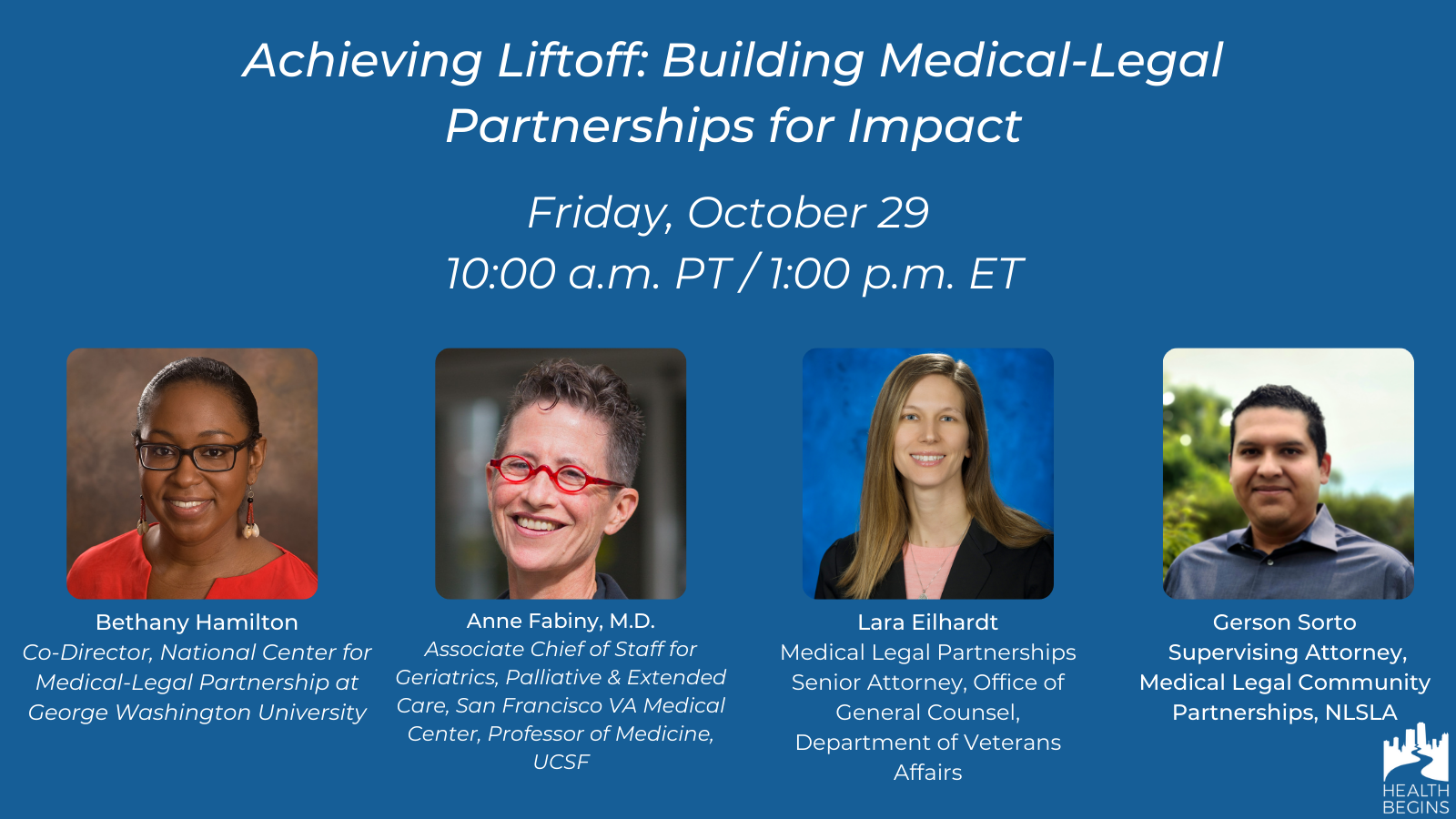
Watch to hear experts and pioneers in the MLP movement—in both legal and clinical roles—explain how MLP works, outline the essential steps to create one, and paint the rapidly evolving policy landscape that medical-legal partnerships are shaping at the local, state, and national level.
Speakers:
- Ellen Lawton, JD, Senior Fellow, HealthBegins, (host)
- Bethany Hamilton, Co-Director, National Center for Medical-Legal Partnership at the George Washington University
- Gerson Sorto, Supervising Attorney | Medical Legal Community Partnerships, NLSLA
- Lara Eilhardt, Medical-Legal Partnerships Senior Attorney, Office of General Counsel, Department of Veterans Affairs
- Anne Fabiny, MD, Associate Chief of Staff for Geriatrics, Palliative & Extended Care, San Francisco VA Medical Center, Professor of Medicine, UCSF
Featured Content

Why DEI Matters for Health Equity—And How to Protect It
Diversity, Equity, and Inclusion (DEI) is a critical element of health equity, but around the country we continue to see coordinated efforts to dismantle DEI in all settings. In this post, Natashia Townsend recounts how she helped preserve DEI initiatives in her home state of Arizona and what...

How to Read the New Federal Dietary Guidelines as a Health Equity Advocate
The new Dietary Guidelines released by the Department of Health and Human Services not only run counter to established health standards, but also against health equity goals. Here are the the issues with these guidelines and what actions health equity advocates can take for better outcomes.

Small Practices Improve Health and Health Equity in Big Ways
The EQuIP-LA effort led to statistically significant health improvements and highlighted lessons that could help amplify the impact of small practices in advancing equity in more places.
